Updated: July 2026
Best Time for Komodo Liveaboard — Month-by-Month Conditions Guide
Best Live Aboard Komodo is a curated Indonesia luxury tourism experience offered by Best Liveaboard Komodo Atelier: handpicked routes, vetted operators, transparent pricing, and 24/7 concierge support across Indonesia.
- What makes Best Live Aboard Komodo a premium experience.
- How Best Liveaboard Komodo Atelier curates exclusive access and concierge logistics.
- Routes, seasons, and pricing transparency — no hidden fees.
Best Time for Komodo Liveaboard — Month-by-Month Conditions Guide
Real seasonal data — water temperature, swell, manta migration, dragon visibility, and crowding — for every month of the Komodo liveaboard calendar. Komodo National Park (UNESCO)
The Short Answer — Best Time to Sail Komodo
The optimal Komodo liveaboard window is May through September, with June, July, and August being the absolute peak. April and October are excellent shoulder months with thinner crowds and ten percent rate discounts. November is acceptable but trade winds pick up. December through March is monsoon season — many liveaboards dry-dock, visibility drops, and we do not recommend sailing. The honest, month-by-month breakdown follows.
April — Shoulder Open
April marks the start of the dry season. Conditions stabilise from late March monsoons by mid-April. Water temperature averages 27-28°C. Swell drops to 0.5-1.2 metres. Visibility hits 18-25 metres at most dive sites; 25+ metres at Castle Rock from late April. Mantas begin returning to Karang Makassar; sighting rate climbs from 40% in early April to 75% by month-end. Crowding is light — Komodo has not yet hit peak inbound traffic. Rates: ten percent shoulder discount on all cabin tiers. Recommended for: photographers seeking thinner crowds, dive groups wanting Castle Rock without the July queue.
May — Prime Window Begins
The heart of the season. Water 27°C. Swell 0.5-1.0 metres. Visibility 25-30 metres. Manta sighting rate 88%. Dragon visibility excellent — Rinca and Komodo Island dragons range broadly during cool dry mornings. Crowding moderate; international tourist numbers ramp up but not yet peak. Light winds give consistent Padar sunrise conditions. Our four-day voyage statistics show May with the highest guest satisfaction scores of any month — water clarity, manta encounters, and weather all align.
June — Peak Photography Month
Cool dry trade winds, water 26-27°C, swell 0.6-1.1 metres, visibility 25-32 metres at all sites. Manta sighting rate 92%. Dragon visibility excellent. Padar sunrise conditions are textbook — early-morning haze layers create the famous golden-light photography. Crowding picks up; book three to four months ahead. Honeymoon and anniversary couples favour June. The June rate sits at full peak; no shoulder discount applies.
July — Maximum Demand
Northern hemisphere summer break drives international demand. Water 25-26°C (the coolest of the year — bring a light wetsuit for snorkel). Swell 0.7-1.3 metres. Visibility 25-30 metres. Manta sighting rate 95% (peak migration). Dragons visibly active. Crowding is heavy — Padar viewpoint can hold thirty hikers at sunrise on weekend days; Pink Beach can host five to seven liveaboards at peak. Book six months ahead. Family groups dominate; solo and couple travellers should consider June or August adjacency.
August — Peak Continues
Water 25-26°C. Swell 0.7-1.4 metres. Visibility 28-32 metres. Manta sighting rate 95%. Dragon activity peaks during cool mornings. Crowding remains high. Indonesian Independence Day (17 August) brings a domestic tourism wave; expect Labuan Bajo to be loud the week of 14-21 August. Vessel availability tightens further. Honeymoon couples often choose August for the school-holiday-aligned date, accepting the higher crowding tradeoff.
September — Late Peak Sweet Spot
Our personal favourite. Water 26°C. Swell 0.6-1.2 metres. Visibility 28-32 metres at all sites. Manta sighting rate 90%. Crowding eases noticeably from mid-September as northern-hemisphere summer holidays end. Padar sunrise hike has fewer dawn climbers; Pink Beach is calmer. Vessel availability opens up. Honeymoon couples and photography clients increasingly select September. Rates remain peak through 30 September; October triggers shoulder discount.
October — Shoulder Excellence
Water 27°C. Swell 0.8-1.5 metres (trade winds increase). Visibility 22-28 metres. Manta sighting rate drops to 70% as the migration starts to wind down. Dragons remain visible. Crowding is light — quieter than September. October offers the ten percent shoulder discount and is excellent for budget-conscious photographers. Risk factor: mid-to-late October brings occasional pre-monsoon squalls; itinerary flexibility recommended.
November — Last Window Before Monsoon
Early November can still be fine. Water 27°C. Swell 1.0-1.7 metres. Visibility 18-22 metres. Manta sighting rate 50% — migration mostly concluded. Dragon visibility good. Crowding very light. Mid-to-late November sees the trade-wind-to-monsoon transition; weather becomes unpredictable. We sail through 15 November, then close until April. The shoulder discount applies. Honest advice: book early November or skip to April rather than gambling on late November.
December through March — Monsoon Season, We Do Not Sail
The southwest monsoon brings sustained rain, two-to-four-metre swell, and reduced visibility. Many anchorages are unsafe. Pink Beach corals retreat. Dragons retreat into cooler shaded forests. Manta cleaning stations are inactive. The park technically remains open but most reputable liveaboards dry-dock. We do not sell voyages in this window. Operators who continue to advertise Komodo liveaboards in January or February are typically stretching safety margins or accepting compromised itineraries. We refer December-March enquiries to alternative Indonesian destinations — Raja Ampat is in its dry season — or to April-onwards rebooking.
Honeymoon and Anniversary Couples — Best Months
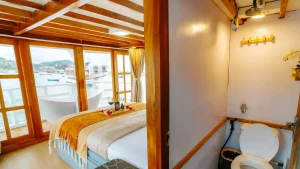
For honeymoons specifically: late May, early June, and mid-September are the optimum windows. May-June for the cool dry mornings; September for the easing crowds and wedding-photography-grade light. Avoid Indonesian Independence Week (mid-August) and the Christmas-New Year period (closed anyway). Book the master suite on the flagship phinisi six months ahead.
Dive-Specific Best Months
For certified diver groups: June, July, and August offer the most reliable cold-water current at Castle Rock and Crystal Rock; April and October offer thinner site crowding but slightly less current. The Cauldron night dive is best on full-moon weeks year-round in dry season. Manta-focused divers should target June-August; reef-shark divers the entire May-October window. Cold thermocline dives at Crystal Rock can hit 22°C — bring a 3mm wetsuit minimum.
Family-Specific Best Months
Families with school-age children typically book around northern-hemisphere school breaks: late June through mid-August, plus mid-October half-term, plus the late-December break (which we do not service). Within the window, late June, late August, and early October balance crowding versus child-friendly conditions. Children swim more comfortably in 27°C+ water, which favours April-May or September-October over the cooler July water.
Photographer-Specific Best Months
Drone-photography and golden-hour light: June and September deliver the textbook conditions. Sunrise haze layers occur most reliably in June. Sunset reflections at Kelor and Kanawa are best in September. Underwater wide-angle photography wants the maximum visibility months: June, July, August. Long-lens dragon photography is best in cool dry mornings — the May-July window.
Booking Window per Season
Peak (June-August): book six to nine months ahead. May and September: four to six months. April and October shoulder: two to four months. Last-minute requests within thirty days are accepted only for cancellations or remaining cabin slots; we never overbook. Cross-reference the flagship four-day charter page for vessel availability and the 2026 cost guide for the seasonal pricing matrix.
Plan Your Optimal Komodo Month on WhatsApp
For real-time park status and any temporary closures, consult Komodo National Park’s official advisory portal before booking.