Updated: May 2026
Wifi, Power and Connectivity on Komodo Liveaboards
Wifi, power and connectivity on Komodo liveaboards are good enough for messaging, email and light work, but not for heavy streaming or constant video calls. Best Liveaboard Komodo uses a mix of 24/7 generators, inverters, local SIM data, hotspots and on some VVIP phinisis, Starlink, yet coverage still drops in remote bays and narrow channels.
How Connected Are You Really in Komodo National Park?
Komodo is remote. Between Labuan Bajo, Padar, Rinca, Komodo Island, Siaba, Sebayur, Gili Lawa and Castle/Rock, you are moving through volcanic islands, steep cliffs and deep channels. That geography is exactly why the diving is so strong – and why mobile signals and wifi can be inconsistent away from main towers.
At Best Liveaboard Komodo, the dedicated liveaboard desk of Komodo Luxury (part of Juara Holding Group, operating Labuan Bajo departures since 2015), we set correct expectations from the start: you can usually stay partially online, but Komodo is not a floating city office. Knowing the limits of wifi power and connectivity on Komodo liveaboards helps you choose the right phinisi class, trip length and work/offline balance for your 3D2N to 7D6N voyage.
For buyers who need deeper trip planning detail, we recommend reading our Best Liveaboard Komodo FAQ and the step‑by‑step guide to 3–7 day Komodo itineraries alongside this connectivity guide.
Wifi Options by Boat Class: VVIP, VIP and Deluxe Phinisi
We do not oversell wifi. Instead, we specify clearly what is typical for each vessel class and departure type we broker in Komodo National Park:
- VVIP phinisi & superyacht class
- Usually equipped with multiple LTE routers using Indonesian SIMs (primarily Telkomsel, occasionally XL/Indosat as secondary networks).
- Many now offer satellite internet (e.g. modern LEO constellations) for primary or backup connectivity. This dramatically improves coverage, yet speeds still vary with weather and congestion.
- Typical use: email, cloud docs, messaging and a few work calls per day for several guests. Continuous HD streaming for multiple cabins is rarely realistic.
- Indicative charter bands: superyachts from roughly USD 5,000–12,000 per day (around USD 830–2,000 per person), weekly private charters from around USD 50,000, and ultra‑luxury phinisi tiers often start around USD 15,000+ per night, depending on vessel, season and group size, with exact quotes confirmed on WhatsApp.
- VIP phinisi & motor yachts
- Typically 1–2 LTE routers with shared wifi throughout saloon and often cabins.
- No satellite on many boats; connectivity depends on proximity to Labuan Bajo and main cell towers.
- Good enough for messaging, social media uploads and occasional calls while in coverage. Expect dead zones near remote dive sites and on some night crossings.
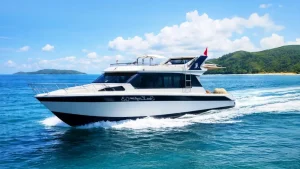
- Motor yacht charters in Komodo usually fall in the USD 1,500–3,000 per day range (roughly USD 250–500 per person), with exact figures varying by yacht size, itinerary and season.
- Deluxe phinisi & shared‑cabin trips
- Most offer basic shared wifi sourced from a single LTE router or hotspot.
- Bandwidth is limited; signal is often strongest near Labuan Bajo, Sebayur and northern Komodo, and weakest around central channels or behind steep islands.
- Expect to use your own phone data as often as the boat’s wifi.
- 1‑day speedboat charters
- Connectivity relies almost entirely on your own phone signal.
- Indicative bands start around USD 400 for a private speedboat for 4–8 guests; this is for the whole boat, not per person, and the exact rate is confirmed case‑by‑case.
For a more granular breakdown of boat categories and comfort levels, our guide to best boats and cabins for Komodo explains how we segment VVIP, VIP and Deluxe classes beyond just internet access.
Power Supply Onboard: Plugs, Voltage and Charging Rules
Regardless of wifi strength, reliable power is fundamental. Most Komodo phinisis and yachts we work with follow similar standards:
- Voltage & sockets
- Typical voltage is 220V AC, 50Hz.
- Outlets are usually European type C/F two‑pin round plugs. Bring adapters if you use US, UK or AU plugs.
- Generators & inverters
- Power usually comes from diesel generators backed by inverters and battery banks to keep essential systems stable at night.
- On higher‑end VVIP and VIP boats, 24/7 power for cabins, air‑conditioning and charging is standard.
- On some Deluxe boats, heavy loads such as cabin AC may pause during certain night hours, but phone and laptop charging usually remain available.
- Charging etiquette
- Most cruises limit high‑draw devices (hairdryers, irons, kettles) in cabins; they can trip breakers or strain the generator.
- Camera, drone and dive‑computer charging is typically concentrated in a dedicated charging station in the saloon or camera room.
- Divers bringing large rigs should check the number of sockets and surge protection in advance.
If you rely on hardware for creative or technical work at sea, our packing guide in Packing List for Komodo Liveaboards details practical power accessories we recommend (multi‑plug extension, travel adapter, power bank, dry bags for electronics).
Mobile Signal, Satellite and Realistic Speeds at Sea
Understanding the layers behind wifi power and connectivity on Komodo liveaboards helps you plan work, calls and uploads realistically.
- Mobile coverage patterns
- Best coverage: around Labuan Bajo, western Flores, and inner‑bay anchorages near Sebayur, Kanawa and some points between Padar and Rinca.
- Variable coverage: central channels, Gili Lawa area, and behind high cliffs or deep bays where the signal hits a “shadow”.
- Limited coverage: far‑flung northern and southern sites, and some drift dive areas such as Castle/Rock where boats may be in open water.
- Typical speeds guests experience
- In good LTE zones on a VVIP or VIP boat, expect a few to tens of Mbps downlink for the group, shared across guests.
- In marginal coverage, speeds can fall to basic 3G or edge-level connectivity, enough for text but not for calls.
- Satellite systems provide a more consistent baseline but still degrade under heavy rain or crowded constellations, and usually have fair‑use limits.
- What usually works well
- WhatsApp and Telegram messages.
- Email sync, basic cloud document editing.
- Occasional audio or short video calls, ideally planned during known coverage windows.
- What is unreliable
- Full days of back‑to‑back Zoom/Teams calls.
- Uploading large raw photo sets or long 4K videos in a single session.
- Simultaneous HD streaming in multiple cabins.
Our planning team can help you map itineraries and signal expectations. For example, a 3D2N route focusing on Padar, Rinca and Pink Beach may offer more coverage windows than a 7D6N itinerary that includes remote northern pinnacles. Our article on exploring lesser‑known dive sites in Komodo explains why the best dives often coincide with weaker connectivity.
Working Remotely from a Komodo Liveaboard
Each year we handle more guests who need some connectivity for work, from time‑sensitive founders to remote employees and content teams. Our approach is to design around your true needs:
- Be honest about your workload
- If you must be online for several hours daily on video, we recommend VVIP or high‑end VIP vessels with satellite backup and careful itinerary selection.
- If you simply need to check emails twice a day, most VIP and many Deluxe phinisis are sufficient during 3D2N, 4D3N or 5D4N trips.
- Schedule key calls
- Plan calls in the mornings or evenings when boats are at anchor near better coverage areas.
- Allow buffer time in case the signal drops as the vessel repositions.
- Use redundancy
- Bring at least one Indonesian SIM (Telkomsel is usually strongest in Komodo) loaded with data.
- Certain guests carry two phones with different providers to switch when one network is weak.
- Download key documents for offline use before boarding.
- Consider partial‑work itineraries
- We frequently design 4D3N and 5D4N charters where days 1 and 4 are “lighter” sailing days with stronger coverage, and central days dedicated fully to diving and hiking.
- Longer trips, like Bali–Komodo crossings of 7–10 days (typically around USD 7,000–15,000 for the vessel depending on size, season and inclusions), cover very remote stretches where full‑work days are unrealistic; these are better framed as mostly‑offline expeditions.
Our deep‑dive piece on liveaboard technology innovations explores how connectivity solutions, from smart routing to AI‑assisted maintenance, are being tested across fleets we work with.
Staying Safe, Responsible and Present While Connected
Connectivity is not just about convenience; it intersects with safety, conservation and the quality of your experience in Komodo National Park.
- Safety communications
- Crew use VHF radios and, on better‑equipped vessels, satellite phones or trackers for emergency communication regardless of wifi status.
- Navigation and weather updates increasingly draw on digital tools; our article on Komodo National Park regulations explains how rules and safety briefings are kept current at the time of writing and reconfirmed before departure.
- Conservation and bandwidth
- High‑bandwidth satellite systems consume power and fuel indirectly through generator loads. We work with owners who balance guest expectations with sustainable Komodo travel practices.
- Many guests schedule “digital‑free” dive days to fully experience manta encounters, Komodo dragons and sunrise hikes on Padar.
- Respecting local culture and crew
- Crew need bandwidth for operational tasks and their own communication; heavy streaming in guest areas can impact this.
- We encourage guests to discuss high‑usage plans with the cruise director so the network stays functional for everyone on board.
For deeper context on how connectivity, tourism growth and conservation intersect in this region, see our analysis of Komodo tourism strategy and the overview of Komodo conservation developments.
If you need specific guidance on wifi, power and connectivity on Komodo liveaboards for your dates, group size and budget band – from 2D1N private phinisi options (often around USD 200–350 per person for groups of eight sharing) to superyacht weeks – contact our specialists on WhatsApp chat or email sales@komodoluxury.com for a detailed, vessel‑by‑vessel briefing.